You're not behind
· 4 min read · 675 words
Claude Opus 4.6 was “the world’s most powerful model” for exactly twenty minutes. Then GPT 5.3 dropped.
This is the new normal. A firehose of tech revolution with permanent anxiety for those building with the hopes to escape the AI underclass.
The only stable ground now is a longer horizon. Build for where tech will be in six months. Voice, agents, robotics. Build for whatever feels janky now but will be obvious in 6 months.
That’s your only edge.
What you’re feeling isn’t wrong
With how fast everything has changed in tech in the past year, it’s so easy to feel like you’re behind, and that you’ll never find success because everything is just moving ahead too fast.
Every week a new tool, model, technique, or research paper is released that seems to change everything. January, 2026 felt like a tipping point where things just hit hyperspeed and even your dad was shipping something.
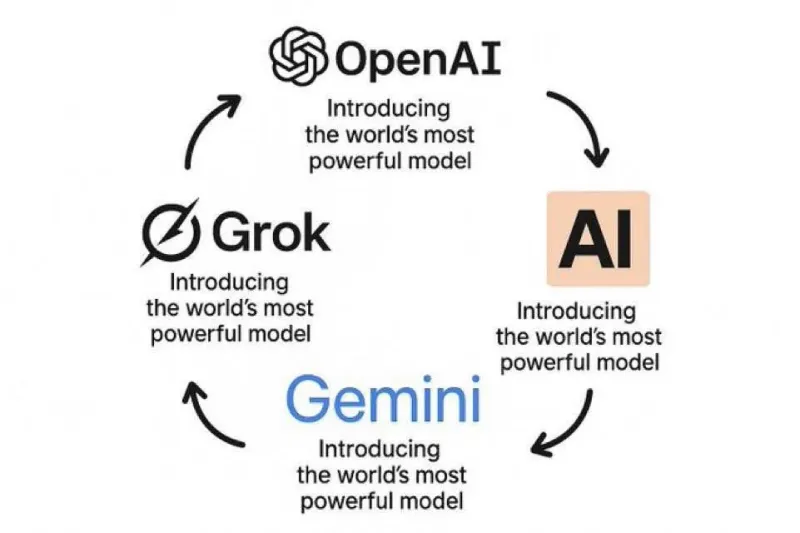
In this environment, every untested AI thing is a lost opportunity. FOMO hits you like a super-sonic passenger plane, and it feels like if you don’t stay a step ahead you’ll just never get ahead at all.
This is absolute nonsense.
The hype is just to make them feel better
Those people launching that new thing? They’re desperately fighting the exact same anxiety about the future as you are.
Hell, with the Opus 4.6 example, Anthropic released another model (Sonnet 4.6) before I even hit publish on this post. It’s only been a week and a half.
The Japanese call this “hon’ne-tatemae” (本音・建前): public face versus true feeling. You see their tatemae, but you feel their hon’ne. You’re both scared, they just have better PR.
If you think the founders running these labs and shipping product after product don’t feel woefully behind, then you’re kidding yourself.
The thing that matters most is building something that people will remember a year from now. In a month, you won’t remember which model dropped, what post went viral, or what press release claimed “software engineering is definitely finished this time guys!”
You need a cognitive filter against this noise.
Mental moats and your edge moving forward
The Claude Code team was given one piece of advice when starting to build their product:
Don’t build for the model of today. Build for the model 6 months from now.
This framing is a mental moat.
A mental moat is cognitive protection that compounds — a way of processing information that makes you harder to destabilize and enables you to act easier. Whereas physical moats protect your assets, we’ll be building moats that protect your cognition, attention, and execution.
Here’s one you can start building right now.
The 6 month filter
Ask yourself one question, “What will be obvious 6 months from now?” You can even take out a note pad and write a sentence describing a product or capability that is janky or non-existent now, but feels inevitable. The point of this is to spot what is emerging before it saturates.
Do you know what the best part is? You can build it. Right now. The barriers have never been lower. Even if the bottleneck is that the models aren’t good enough for the task, they will be in 6 months.
Is it obvious that vision, voice, reasoning, and image gen models will converge? Build for that.
Is it obvious that agent orchestrators will be the next big thing? Build it.
This mindset compounds silently and fast, because it’s a cognitive filter that separates noise from signal. Whereas a new model drop or product launch would cause others to panic, you shrug your shoulders knowing that it was inevitable, and you already built for the current state 6 months ago.
Lock in on the next 6 months
Look, the reality is, it’s hard to not feel behind. It’s in your nature as a builder to want to be on the cutting edge, and if you just focus on doing things for where AI will be 6 months from now, you’ll always be ahead.
See you space cowboy…
Peer review credits
Shout out to @skeptrune and @TomthaBomb34 for reading through this post and giving feedback.